


AI adoption continues despite investor skepticism
The AI-powered stock market boom in the US has lost momentum as investor concerns grow over whether massive capital expenditure will translate into sustainable profits and justify sky-high valuations. But the rapid rollout of AI across the real economy – most notably in banking – tells a very different story. What explains this divergence?
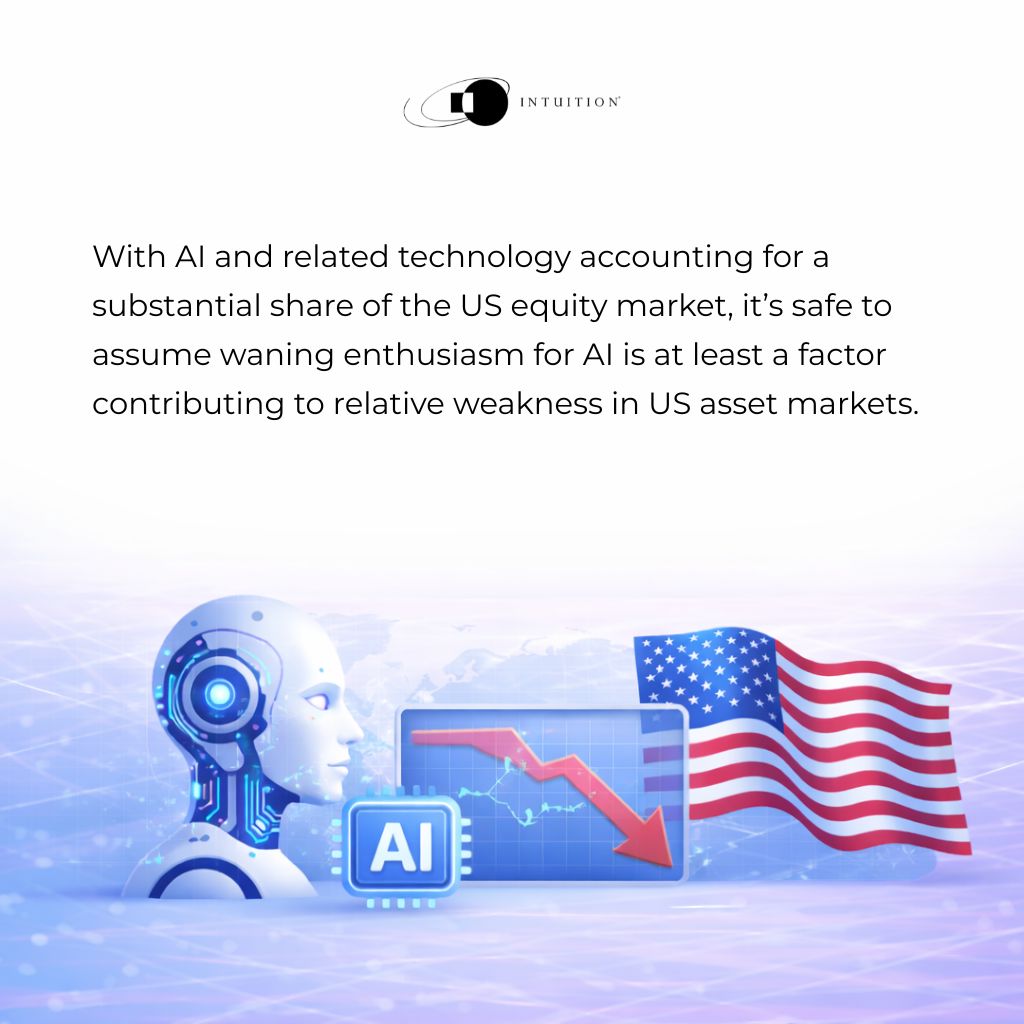
2025 marked the first year in several where non-US markets outperformed the US – a notable shift given the outsized role of US technology and AI-linked firms in global indices. With AI and related technology accounting for a substantial share of the US equity market, it’s safe to assume waning enthusiasm for AI is at least a factor contributing to relative weakness in US asset markets. This tallies with growing caution on the AI boom even among those at the center of it, with Alphabet boss Sundar Pichai recently pointing to “irrationality” and saying that a bust would affect everyone.
Investor concerns
What explains the diminishing enthusiasm among investors?
Many factors have been cited, but the themes that recur most frequently in the investor community are:
Valuations: AI-linked equities are priced for exceptional outcomes, implying rapid and widespread adoption, sustained pricing power, and a short path from investment to profitability. Such valuations leave little margin for error – even modest delays in monetization or lower-than-expected margins can prompt sharp reassessments.
Capital expenditure and overcapacity: Investment in AI infrastructure has surged to unprecedented levels, spanning data centers, specialized chips, energy supply, and cooling. Investors fear that constraints around power availability, grid connections, supply chains, and environmental limits will further raise costs and threaten returns on invested capital. While this capex is often framed as long-term investment, there is growing concern that it could result in overcapacity if demand scales more slowly or less broadly than expected.
Productivity translation: AI has demonstrated impressive capabilities in areas such as writing, coding, and analytical support, but productivity gains at this level do not automatically translate into economy-wide improvements. Realizing meaningful benefits requires process redesign, data standardization, sound governance, workforce training, and organizational change – these are potential frictions that suggest it could take much longer for current market valuations to materialize, if they materialize fully at all.
Competition and commoditization: As AI models and tools proliferate, and as open-source or “good enough” alternatives become widely available, pricing power may prove difficult to sustain. In this environment, AI risks becoming a broadly accessible input rather than a durable source of competitive advantage. The emergence of lower-cost platforms, including from China, has sharpened concerns that rapid commoditization could compress margins across the sector.
Intuition launches new retail credit and AI tutorials in Know-How

AI adoption in banking
While investor enthusiasm for AI may have waned, adoption of AI across the economy – including in banking – continues unabated. In banks, AI is increasingly viewed as a practical tool to enhance efficiency, risk management, and control. Early deployments focused on machine learning (ML), but advances in generative AI (GenAI) and large language models (LLMs) extend AI capabilities into language processing, document analysis, and customer interaction. Adoption remains incremental and task-specific, with different AI techniques applied where they add most value. The following areas illustrate this shift:
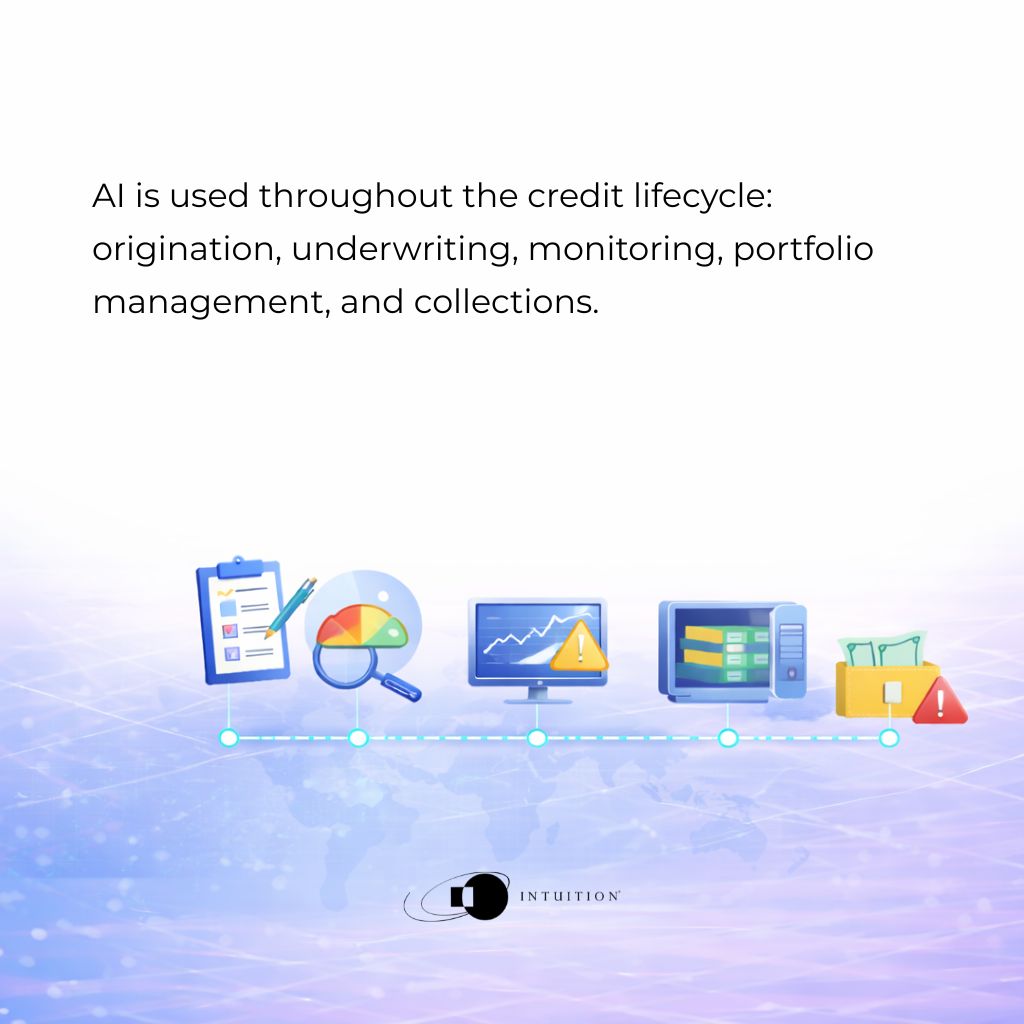
Credit risk analysis: AI is used throughout the credit lifecycle: origination, underwriting, monitoring, portfolio management, and collections. ML models handle large, structured datasets (credit scores, income, debt) and capture complex, non-linear relationships, improving risk assessment and early-warning signals. GenAI and LLMs complement ML by processing unstructured data such as bank statements, customer communications, supporting documents, and narrative credit notes. In corporate and SME lending, LLMs can summarize financial statements, extract key risk factors from long documents, and assist relationship managers by synthesizing qualitative information, all while leaving final credit decisions to human reviewers.
Trading and markets: AI extends decades of trading technology evolution, from floor-based to electronic to algorithmic execution. Machine learning adapts to historical patterns for execution optimization, market-impact modelling, and liquidity analysis. GenAI and LLMs analyze unstructured and semi-structured data – news, earnings calls, research reports, images, or satellite data. These tools help traders and risk managers summarize information, identify emerging trends, and stress-test portfolios against hypothetical scenarios, enhancing situational awareness without claiming to “predict” markets.
Customer service and client interaction: Generative AI and LLMs power chatbots, virtual assistants, and roboadvisors, enabling banks to respond to customer inquiries quickly and at scale. These tools handle routine questions, provide personalized guidance on products, and support investment or savings advice, while humans retain oversight for complex or high-risk interactions.
Fraud detection and financial crime: Traditional rules-based systems classify transactions but grow overly complex and brittle over time. ML models detect evolving patterns across large transaction datasets, improving detection and adaptability. GenAI/LLMs analyze unstructured inputs – customer communications, alerts, case notes – helping investigators prioritize cases, reduce false positives, and highlight key risk indicators. These models maintain auditability and human oversight, critical in regulated environments.
A pragmatic path to adoption
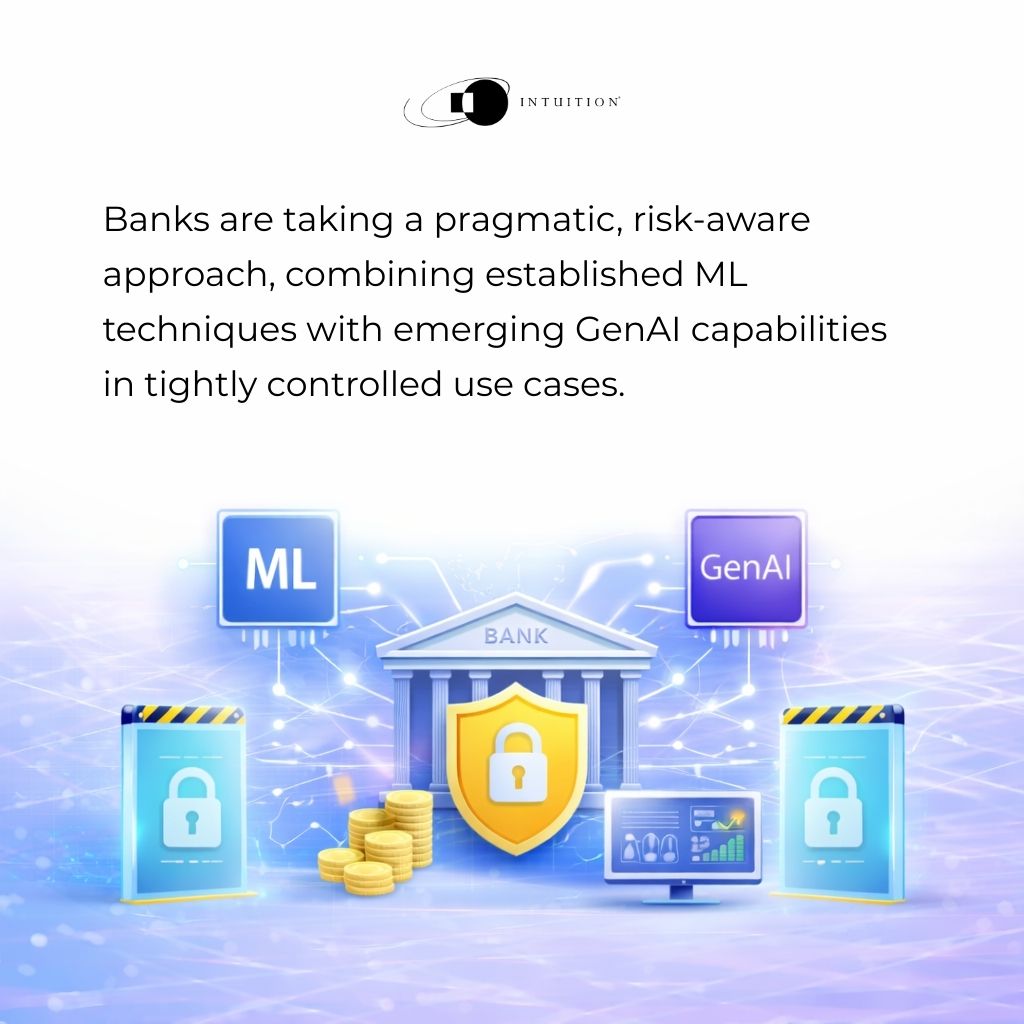
While AI has fueled dire predictions about job losses – Citibank research suggests it could automate or materially augment over half of banking roles, particularly in back-office, operations, and data-heavy functions – its deployment in banking has been evolutionary rather than revolutionary. Banks are taking a pragmatic, risk-aware approach, combining established ML techniques with emerging GenAI capabilities in tightly controlled use cases, with humans remaining in the loop to provide oversight and final authority across the board but particularly in governance, explainability, data quality, and regulatory compliance.
To summarize, even as investors debate the pace and profitability of AI at the market level, its practical adoption within banks continues to expand – driven less by speculative expectations and more by tangible operational benefits.
Conclusion
There’s nothing unusual about the growing gap between market expectations and continued real-world adoption. In fact, such divergences are a recurring feature of major technological shifts, such as the railroad or the Internet. The dotcom boom of the late 1990s led to overinvestment, overcapacity, and ultimately a market crash, with telecoms and internet infrastructure hit especially hard. Yet this did little to prevent the internet from reshaping commerce, communication, and daily life.
AI may follow a similar path. A bear market in equities – or even a crash – would not imply failure of the technology itself, but rather a repricing of unrealistic expectations around timing, margins, and winners. For firms and workers alike, the more relevant question is not whether AI valuations hold up, but how deeply the technology becomes embedded in everyday business processes.
Intuition Know-How has a number of tutorials relevant to the content of this article:
- AI & GenAI – An Introduction
- AI Implementation
- Responsible AI
- AI Ethics – An Introduction
- AI Applications – Trading
- AI Applications – Portfolio Management
- AI Applications – Customer Services
- AI Applications – Retail Credit Risk
- AI Applications – Corporate Credit Risk
- AI Applications – Fraud Detection & Prevention
- AI Applications – Regulatory Compliance
- AI Applications – Derivatives Pricing
- Equity Markets – An Introduction
- US Equity Markets
