


Top 6 challenges for risk teams in 2026
About Intuition
Since 1985, Intuition has partnered with leading financial institutions and Fortune 500 companies worldwide to build capability in complex, regulated environments. As an end-to-end strategic learning partner, we help organizations identify, design, and deliver the knowledge and skills their teams need to succeed. Our risk development programs focus on helping risk functions become trusted partners in decision making across the business.
***
If you step back and look at how risk functions are operating today, it’s clear that the environment has become more complex, but not always in obvious ways.
Most teams would say they have strong frameworks in place, clear governance structures, and access to more data than ever before. And all of that is true. But at the same time, the day-to-day experience of managing risk feels more fragmented, more pressured, and, in many cases, less predictable than it did even a few years ago.
What’s emerging is not one single challenge, but a set of interconnected ones. And while each of these shows up in slightly different ways across organizations, they are consistently reflected in how risk is described, taught, and experienced in practice.
Why traditional risk training falls short in 2026
Table of contents
- Regulation is evolving faster than it can be applied
- Reporting has expanded, but clarity hasn’t always followed
- Data is widespread, but not always dependable
- Technology is introducing new forms of operational risk
- Emerging risks are harder to define and measure
- Capability is becoming the limiting factor
This article is also available in podcast/video form. Watch the video below from our YouTube channel, or follow The Intuition Finance Digest on Spotify, Apple Podcasts, or Amazon Music.
1. Regulation is evolving faster than it can be applied
There’s no shortage of regulatory guidance. In fact, most risk teams are dealing with multiple regulators, overlapping requirements, and a steady stream of updates, particularly in areas like ESG, AI, and digital assets.
What’s interesting, though, is that even within structured learning material, the same pattern comes up again and again. Regulation continues to expand, but the real difficulty lies in interpretation, understanding what new requirements actually mean in practice, and how they should be applied consistently across the organization.
That translation layer is where most of the effort sits, and it rarely happens in a clean or linear way.
The risk management market was valued at $15.40 billion in 2024 and is projected to reach $51.97 billion by 2033, growing at 14.6% CAGR.
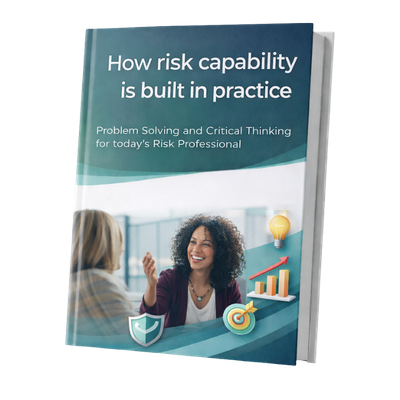
How risk capability is built in practice
This document outlines how we work with risk teams to develop problem-solving and critical thinking capability in practice. It shows how we help risk professionals move from risk avoidance toward risk intelligence, and from rule enforcement toward informed decision support, using real scenarios, practical frameworks, and learning designed to scale.
2. Reporting has expanded, but clarity hasn’t always followed
At the same time, reporting requirements have grown significantly, particularly since the introduction of post-crisis reforms.
In theory, more reporting should mean more transparency. In practice, the opposite can happen. Information is spread across multiple formats, data sits in different systems, and timelines don’t always align.
Even in formal material, reporting is often described as fragmented, with different stakeholders requiring different views of the same underlying data. So while the volume of reporting has increased, turning that into something clear and decision-ready is still a challenge.
3. Data is widespread, but not always dependable
This naturally leads into data.
Most organizations are not short on it, but when you look more closely, issues around quality, ownership, and integration start to appear. Data can be duplicated, incomplete, or inconsistent, particularly where legacy systems or recent changes are involved.
This is a theme that comes up repeatedly, the need to validate and reconcile data before it can be used. In practice, that means risk teams are often spending as much time preparing data as they are analyzing it, which slows everything down and introduces a level of uncertainty into the process.
4. Technology is introducing new forms of operational risk
Alongside this, the technology environment continues to evolve.
Cloud infrastructure, remote working, third-party providers, and increasingly AI-driven tools have all improved efficiency, but they have also introduced new forms of operational risk. Outages, cyber threats, vendor dependencies, and system vulnerabilities are now part of the everyday landscape.
Even in structured examples, system migrations and technology failures are highlighted as real sources of disruption. So while technology solves a number of problems, it also creates new ones that need to be actively managed.
5. Emerging risks are harder to define and measure
Then there are the newer categories of risk; climate, AI, digital assets, which are now firmly part of the conversation, but still developing in terms of how they are measured and governed.
What stands out here is the lack of standardization. There are no universally agreed metrics, limited historical data, and evolving methodologies. That makes it harder to quantify exposure, set meaningful limits, or build consistent governance frameworks.
In many cases, risk teams are building the approach at the same time as they are managing the risk itself.
6. Capability is becoming the limiting factor
And sitting across all of this is a more practical challenge, which is capability.
Risk teams are being asked to cover more ground, across more complex topics, using more advanced tools. At the same time, the importance of skill, judgment, and risk culture is repeatedly emphasized, particularly in how effectively frameworks are applied in practice.
The challenge is that capability doesn’t always develop evenly. And when that happens, it shows up in how decisions are made, how clearly risk is communicated, and how confidently teams are able to act.
None of these challenges are entirely new in isolation. What’s different is the way they are now combining.
Regulation, reporting, data, technology, and emerging risks are all evolving at the same time. And the consistent theme running through all of them is that structure alone is no longer enough.
The frameworks are still essential, but the effectiveness of risk management increasingly depends on how they are interpreted, applied, and connected in practice.
Which brings things back to people.
Because in a more complex and less predictable environment, the ability to make sense of what’s happening, and to act on it with clarity, is what ultimately defines how well risk is managed.
Frequently asked questions
Why is regulation such a major challenge for risk teams in 2026?
Risk teams are dealing with expanding guidance from multiple regulators, especially in areas such as ESG, AI, and digital assets. The challenge is not simply keeping up with updates. It is understanding what those requirements mean in practice and applying them consistently across the organization. That interpretation stage often takes the most effort and rarely unfolds in a straightforward way.
Why has more reporting not automatically led to more clarity?
Reporting requirements have grown significantly, particularly since post-crisis reforms such as Pillar 3. But more reporting does not always produce better visibility. Information is often spread across multiple formats, stored in different systems, and needed by different stakeholders on different timelines. As a result, risk teams still face difficulty turning large volumes of reporting into something clear, usable, and decision-ready.
What data issues are making risk management harder?
Most organizations have access to a great deal of data, but that does not mean the data is dependable. Common problems include duplication, inconsistency, incomplete records, and unclear ownership, especially where legacy systems or recent changes are involved. Because of this, risk teams often spend substantial time validating and reconciling data before they can analyze it, which slows decision-making and adds uncertainty.
How is technology creating new operational risks for risk teams?
Technology has improved efficiency, but it has also introduced new sources of operational risk. Cloud infrastructure, remote working, third-party providers, and AI-driven tools all create possible points of disruption. Outages, cyber threats, vendor dependencies, and system vulnerabilities are now part of everyday risk management. Even technology upgrades and migrations can create instability, so the same systems that improve performance also need careful oversight.
Why are emerging risks like climate, AI, and digital assets harder to manage?
These risks are now firmly part of the conversation, but the methods for measuring and governing them are still developing. There is limited historical data, no universally agreed metrics, and evolving approaches to assessment. That makes it harder for risk teams to quantify exposure, define limits, and build consistent governance frameworks. In many cases, they are still designing the approach while also managing the risk itself.
Why is capability becoming the limiting factor for risk teams?
Risk teams are being asked to manage more complexity across regulation, reporting, data, technology, and emerging risks, often with more advanced tools. At the same time, effective risk management still depends on skill, judgment, and risk culture. When capability develops unevenly, it affects how frameworks are applied, how clearly risk is communicated, and how confidently teams can make and support important decisions.
How risk capability is built in practice
This document outlines how we work with risk teams to develop problem-solving and critical thinking capability in practice. It shows how we help risk professionals move from risk avoidance toward risk intelligence, and from rule enforcement toward informed decision support, using real scenarios, practical frameworks, and learning designed to scale.
