


Iran war upends commodities market
The old assumption that commodities markets were primarily driven by supply, demand and economic growth has been overtaken by events. Perhaps like never before, the Iran war has underlined that commodities are geopolitical assets.
The initial market reaction to the Iran conflict was predictable. Crude oil prices surged by around 57% and gold rallied, while freight and insurance costs also rose sharply.
What at first appeared to be a temporary, regional shock has since evolved into something more fundamental. The threat of closure of the Strait of Hormuz – through which roughly one fifth of global oil and a significant share of LNG flows – has transformed a localized conflict into a broader, system-wide commodities shock.
Oil, gas, metals, agricultural products, and even shipping routes are increasingly being priced not just on consumption trends, but on military risk, strategic vulnerability, sanctions exposure, freight disruption, and inflation expectations. The announcement that Indonesia, a major commodities producer, plans to centralize exports through a state-run agency reinforces this shift.
For a broader view of how financial markets are responding to the Iran conflict, read our related article: Markets attempt to look through Iran conflict for now.
This article is also available in podcast/video form. Watch the video below from our YouTube channel, or follow The Intuition Finance Digest on Spotify, Apple Podcasts, or Amazon Music.
Oil price building in a “war premium”
Historically, oil prices were largely governed by economic growth, OPEC production discipline, and inventory levels. Today, naval maneuvers and military escalation are just as important.
The effects extend beyond direct supply disruption: elevated geopolitical risk has introduced a persistent “war premium” into crude oil prices, adding a new layer of risk on top of the traditional commodities cycle.
Despite the price escalation to date, some commentators warn that the oil price could move significantly higher and that markets remain relatively complacent based on current futures pricing. While the UAE’s departure from OPEC may support additional supply, others argue that large Chinese reserve buffers have masked the true impact of the crisis, leaving the market yet to fully price in the potential supply shock.
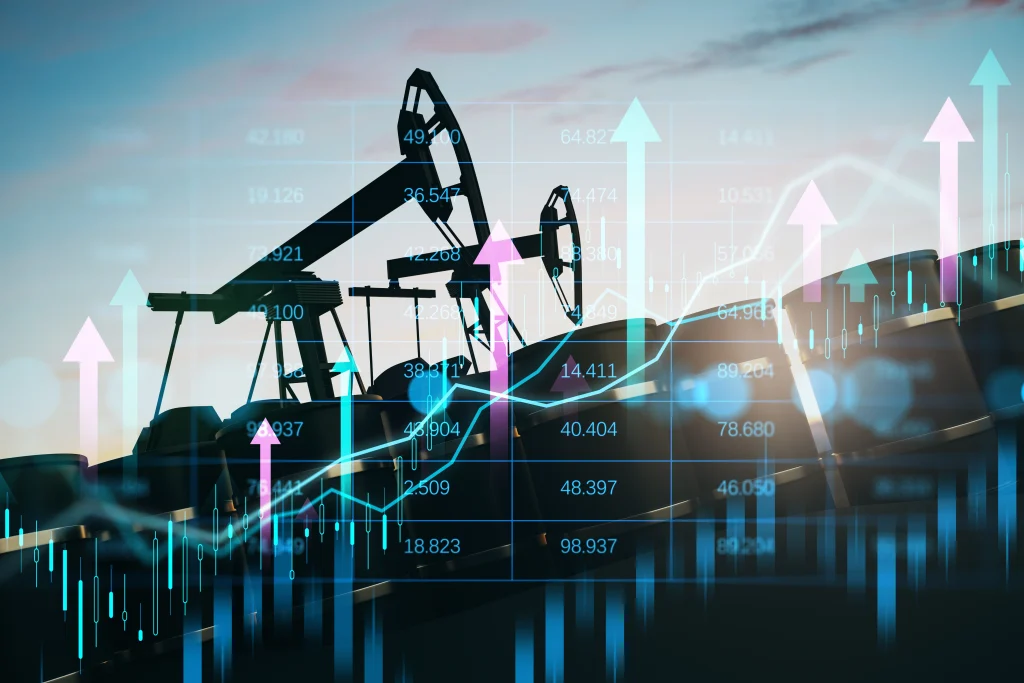
Oil markets are no longer reacting only to supply and demand, but also to military escalation and geopolitical risk.
Impact on oil products intensifies
Within the broader energy complex, the impact of the conflict extends well beyond crude oil. Refined products such as diesel, jet fuel, and gasoline may be even more sensitive, as global refining capacity remains tight following years of underinvestment and ESG-driven capital restraint.
This leaves airlines, shipping firms, and logistics operators exposed not only to higher crude prices, but also to wider refining spreads and transport disruption. The aviation sector, for example, illustrates how higher jet fuel costs linked to the Iran conflict can feed through into ticket prices, with effects rippling across tourism, freight, manufacturing, and consumer price.
Natural gas a hostage to geopolitics
Russia’s invasion of Ukraine showed how natural gas and LNG markets are hostage to geopolitical events. The Iran conflict reinforces that lesson, illustrated by damage sustained by Qatar, a country at the heart of global LNG supply.
Any threat to Gulf shipping immediately reverberates through Asian and European gas markets. With LNG exports and liquefaction facilities facing disruption, sharp price spikes in spot LNG markets leave Asian importers – particularly Japan, South Korea, Taiwan, and India – facing renewed concerns over supply security and affordability.
The result is that governments are once again prioritizing energy security over pure market efficiency. Strategic reserves, long-term contracts, domestic production capacity, and supply diversification are once again at the center of policymaking. Permanently frictionless global energy trade can no longer be assumed.
The Iran conflict reinforces how quickly LNG and natural gas markets can be disrupted by geopolitical events and shipping risks.
Gold a hedge against political turmoil
Gold’s reaction to events signals another structural shift. Traditionally, gold rallies during geopolitical crises as investors seek safe havens. Yet while gold initially strengthened on the outbreak of war, inflation concerns and expectations of higher interest rates created periods of volatility and profit-taking, against a backdrop of rising US Treasury yields.
Nonetheless, investors increasingly view gold not merely as an inflation hedge but as protection against geopolitical turmoil. Gold prices were already supported by strong central bank buying in recent years, reflecting declining trust in dollar-centric reserve systems. The Iran conflict has intensified these concerns.
Other precious metals are likewise affected. Silver, platinum, and palladium serve both industrial and safe-haven functions. Supply chains for many of these metals remain geographically concentrated and vulnerable to sanctions, export controls, or transport disruption.
Knock-on effects on metals
Aluminum prices have surged amid fears of supply disruption and rising energy costs. Copper markets have also become increasingly sensitive to geopolitical risk, given copper’s central role in electrification, defense systems, grid infrastructure, and AI-related industrial expansion.
While ferrous markets such as iron ore and coking coal are less directly exposed to geopolitical chokepoints (with supply largely originating from Australia and Brazil), they are still affected through higher energy costs, freight disruption, and shifts in industrial demand.
In a world moving toward economic nationalism and strategic industrial policy, these materials are increasingly treated as strategic assets.
Metals are becoming strategic assets as energy costs, industrial policy, and geopolitical risk reshape global supply chains.
Agricultural commodities and food security risks
Agricultural commodities have not escaped. Oil shocks feed directly into food inflation, as modern agriculture is heavily dependent on fuel, fertilizer, and transport. Fertilizer markets are particularly exposed, with significant volumes of urea and sulfur transiting Gulf shipping routes.
As a result, the Iran conflict has heightened concerns over food security. Wheat, corn, and soybean markets have all reacted to fears of higher transport and fertilizer costs. Countries already vulnerable to food inflation and import dependency face renewed pressure.
Even where physical supply continues to flow, commodity traders face a new reality of higher transport costs, prolonged marine insurance premiums, and the diversion of shipping routes around conflict zones.
Commodities volatility inherently inflationary
This matters because modern commodity markets are deeply financialized, and volatility itself can become inflationary. Businesses facing unpredictable energy and raw material costs delay investment, reduce inventory exposure, and pass higher costs on to consumers.
Analysts warn that the true economic damage from geopolitical conflict lies not simply in higher prices, but in persistent uncertainty and the risk of market paralysis. Bond markets reflect concerns that prolonged commodity inflation could force central banks to keep interest rates higher for longer.
The conclusion is unavoidable. Commodities are no longer merely cyclical assets responding to economic growth; they are strategic instruments in an era of geopolitical turbulence.
The same combination of geopolitical volatility, inflation pressure, and higher-for-longer interest rates is also affecting other asset classes, as explored in our article: Investors exit private credit.
Intuition Know-How has a number of tutorials relevant to the content of this article:
-
Commodities – An Introduction
- Commodities – Crude Oil
- Commodities – Oil Products
- Commodities – Natural Gas
- Commodities – LNG
- Commodities – Precious Metals
- Commodities – Ferrous Metals
- Commodities – Nonferrous Metals
- Commodities – Softs
- Inflation – An Introduction
- Inflation Indicators
- Monetary Policy
- Equity Markets – An Introduction
- Bond Markets – An Introduction
Frequently asked questions
How has the Iran war changed the way commodities markets are priced?
The article argues that commodities markets are now being priced less as purely cyclical markets and more as geopolitical assets. Oil, gas, metals, agricultural products, and shipping routes are increasingly shaped by military risk, sanctions exposure, strategic vulnerability, freight disruption, and inflation expectations, rather than only by supply, demand, and economic growth.
Why is the Strait of Hormuz important for commodities markets?
The Strait of Hormuz is important because roughly one fifth of global oil and a significant share of LNG flows through it. The article explains that the threat of closure has turned the Iran conflict from a localized regional shock into a wider commodities shock, affecting energy prices, shipping costs, insurance, and global supply security.
What does a war premium mean for oil prices?
A war premium means oil prices are carrying an additional layer of risk linked to geopolitical conflict and military escalation. The article notes that oil prices are no longer shaped only by economic growth, OPEC production discipline, and inventories. Naval maneuvers, escalation risks, and potential supply disruption are now also influencing crude oil pricing.
Why could refined oil products be more sensitive than crude oil?
Refined products such as diesel, jet fuel, and gasoline may be more sensitive because global refining capacity remains tight after years of underinvestment and ESG-driven capital restraint. This means airlines, shipping firms, and logistics operators face not only higher crude prices, but also wider refining spreads and transport disruption that can feed into consumer prices.
How does the Iran conflict affect natural gas and LNG markets?
The article says the Iran conflict reinforces how natural gas and LNG markets are vulnerable to geopolitical events. Any threat to Gulf shipping can affect Asian and European gas markets, especially where LNG exports and liquefaction facilities face disruption. This has renewed concerns around supply security, affordability, strategic reserves, long-term contracts, and supply diversification.
Why can commodities volatility become inflationary?
Commodities volatility can become inflationary because unpredictable energy and raw material costs make businesses delay investment, reduce inventory exposure, and pass higher costs to consumers. The article also notes that prolonged commodity inflation can influence bond markets and may push central banks to keep interest rates higher for longer.
Learn more about financial regulation, and build your expertise across modern financial markets with our Know-How financial learning platform.
Click here to learn more, or fill out the form below.
Browse full tutorial offering