


Early Careers Capabilities
Structured early careers programs designed to build financial fluency through deliberate sequencing and real financial context.
Access a short case study exploring how early careers programs are designed and delivered with Intuition.
What is the business problem
Most early careers programs look strong on paper. They are comprehensive, tightly scheduled, and full of content. New hires move quickly through structured pathways and are exposed to complex topics early. However, strong presentation does not always translate into strong outcomes. Some programs consistently produce confident, capable professionals, while others require repeated reinforcement later. The difference is rarely effort or intent. The difference is design.
Many programs fail because they are assembled rather than engineered. Content is often treated as the solution, with little attention paid to how capability actually develops over time. Evidence from effective early careers design shows that learning sticks when it mirrors real work, is grounded in authentic financial context, and is reinforced through application, mentoring, assessment, and reflection.
Just 7% of employers currently use AI in their recruitment process, but 41% plan to expand use within the next year—particularly in sourcing, screening, and assessments.
Source: Early Careers Employer Survey 2025 (University of Limerick)
Programs built as integrated learning journeys combine structured foundations, applied projects, simulations, peer interaction, and ongoing feedback so that new hires do not simply complete content but progressively build financial fluency. Without this deliberate structure, organizations end up relying on assumptions rather than evidence, creating uneven capability across cohorts and inconsistent readiness for complex roles.
Early careers programs succeed or fail at the design level. Volume of content is not the defining factor. What matters is how effectively learning is sequenced, how closely it reflects real financial context, and how consistently it is reinforced over time. For complex global institutions, this is no longer a differentiator. It is becoming a necessity. Programs that are not intentionally designed risk producing uneven capability, slower progression, and weaker long-term outcomes.
What is the business problem
Most early careers programs look strong on paper. They are comprehensive, tightly scheduled, and full of content. New hires move quickly through structured pathways and are exposed to complex topics early. However, strong presentation does not always translate into strong outcomes. Some programs consistently produce confident, capable professionals, while others require repeated reinforcement later. The difference is rarely effort or intent. The difference is design.
Many programs fail because they are assembled rather than engineered. Content is often treated as the solution, with little attention paid to how capability actually develops over time. Evidence from effective early careers design shows that learning sticks when it mirrors real work, is grounded in authentic financial context, and is reinforced through application, mentoring, assessment, and reflection.
Just 7% of employers currently use AI in their recruitment process, but 41% plan to expand use within the next year—particularly in sourcing, screening, and assessments.
Source: Early Careers Employer Survey 2025 (University of Limerick)
Programs built as integrated learning journeys combine structured foundations, applied projects, simulations, peer interaction, and ongoing feedback so that new hires do not simply complete content but progressively build financial fluency. Without this deliberate structure, organizations end up relying on assumptions rather than evidence, creating uneven capability across cohorts and inconsistent readiness for complex roles.
Early careers programs succeed or fail at the design level. Volume of content is not the defining factor. What matters is how effectively learning is sequenced, how closely it reflects real financial context, and how consistently it is reinforced over time. For complex global institutions, this is no longer a differentiator. It is becoming a necessity. Programs that are not intentionally designed risk producing uneven capability, slower progression, and weaker long-term outcomes.
Why it matters
Early careers programs are no longer a “nice to have.” For complex global institutions, they are becoming an operational necessity. Poorly designed programs create uneven capability, slower progression, and inconsistent readiness across cohorts. Well-designed programs do the opposite: they accelerate fluency, strengthen confidence, and support long-term performance.
Financial fluency at the early careers stage enables new professionals to understand how their role connects to the broader organization. When that understanding is built early, individuals engage more effectively with advanced topics, make stronger decisions, and adapt as roles evolve.
The difference is not time spent or content delivered. The difference is whether learning mirrors real work, is reinforced over time, and is intentionally designed rather than assumed.
Clarity of role and context
Graduates understand how their work connects to the broader institution.
Stronger foundations for advanced topics
Solid financial foundations support faster progression into complex concepts.
Faster, more consistent progression
Cohorts develop capability more evenly, reducing performance gaps.
Why it matters
Early careers programs are no longer a “nice to have.” For complex global institutions, they are becoming an operational necessity. Poorly designed programs create uneven capability, slower progression, and inconsistent readiness across cohorts. Well-designed programs do the opposite: they accelerate fluency, strengthen confidence, and support long-term performance.
Financial fluency at the early careers stage enables new professionals to understand how their role connects to the broader organization. When that understanding is built early, individuals engage more effectively with advanced topics, make stronger decisions, and adapt as roles evolve.
The difference is not time spent or content delivered. The difference is whether learning mirrors real work, is reinforced over time, and is intentionally designed rather than assumed.
Clarity of role and context
Graduates understand how their work connects to the broader institution.
Stronger foundations for advanced topics
Solid financial foundations support faster progression into complex concepts.
Faster, more consistent progression
Cohorts develop capability more evenly, reducing performance gaps.
How Intuition solves it
As a premier training organization, Intuition does not simply manage programs. We engineer transformative learning experiences. We partner with leading banks, embedding ourselves within their teams to craft bespoke, end-to-end graduate programs that ignite potential and drive rapid career progression.
Intuition’s expertise lies in cultivating high-performing individuals. We seamlessly blend rigorous technical training with targeted professional and leadership development, ensuring graduates are not just ready, but primed to excel. Learn how Intuition supports early capability development through structured pre-boarding, ensuring graduates build foundational financial fluency before entering their roles in our guide: How to preboard finance graduates with Know-How.
We champion transparent communication and proactive collaboration. Our agile approach allows us to anticipate challenges and maintain momentum, delivering impactful programs on time and within budget.
Intuition’s structured project management framework leverages cutting-edge tools and analytics to track progress, mitigate risk, and ensure continuous improvement. We don’t just meet expectations, we exceed them, consistently delivering exceptional value for our clients.
At Intuition, capability is built progressively, through deliberate sequencing, real-world applications, and continuous reinforcement. Each stage of the journey plays a specific role in developing financial fluency, ensuring graduates move from foundational understanding to confident performance in real roles.

Assess
Skills gap analysis to replace assumptions with evidence.

Foundation
Structured eLearning to establish a shared financial language across cohorts.

Reinforce
Instructor-led sessions grounded in real financial scenarios.

Apply
Applied projects and simulations that mirror real work.

Reflect
Mentoring and peer learning to deepen understanding in context.

Progress
Reflection and assessment to reinforce learning over time.

How Intuition solves it
As a premier training organization, Intuition does not simply manage programs. We engineer transformative learning experiences. We partner with leading banks, embedding ourselves within their teams to craft bespoke, end-to-end graduate programs that ignite potential and drive rapid career progression.
Intuition’s expertise lies in cultivating high-performing individuals. We seamlessly blend rigorous technical training with targeted professional and leadership development, ensuring graduates are not just ready, but primed to excel.
We champion transparent communication and proactive collaboration. Our agile approach allows us to anticipate challenges and maintain momentum, delivering impactful programs on time and within budget.
Intuition’s structured project management framework leverages cutting-edge tools and analytics to track progress, mitigate risk, and ensure continuous improvement. We don’t just meet expectations, we exceed them, consistently delivering exceptional value for our clients.
At Intuition, capability is built progressively, through deliberate sequencing, real-world applications, and continuous reinforcement. Each stage of the journey plays a specific role in developing financial fluency, ensuring graduates move from foundational understanding to confident performance in real roles.
Assess
Skills gap analysis to replace assumptions with evidence.
Foundation
Structured eLearning to establish a shared financial language across cohorts.
Reinforce
Instructor-led sessions grounded in real financial scenarios.
Apply
Applied projects and simulations that mirror real work.
Reflect
Mentoring and peer learning to deepen understanding in context.
Progress
Reflection and assessment to reinforce learning over time.

Supporting Products
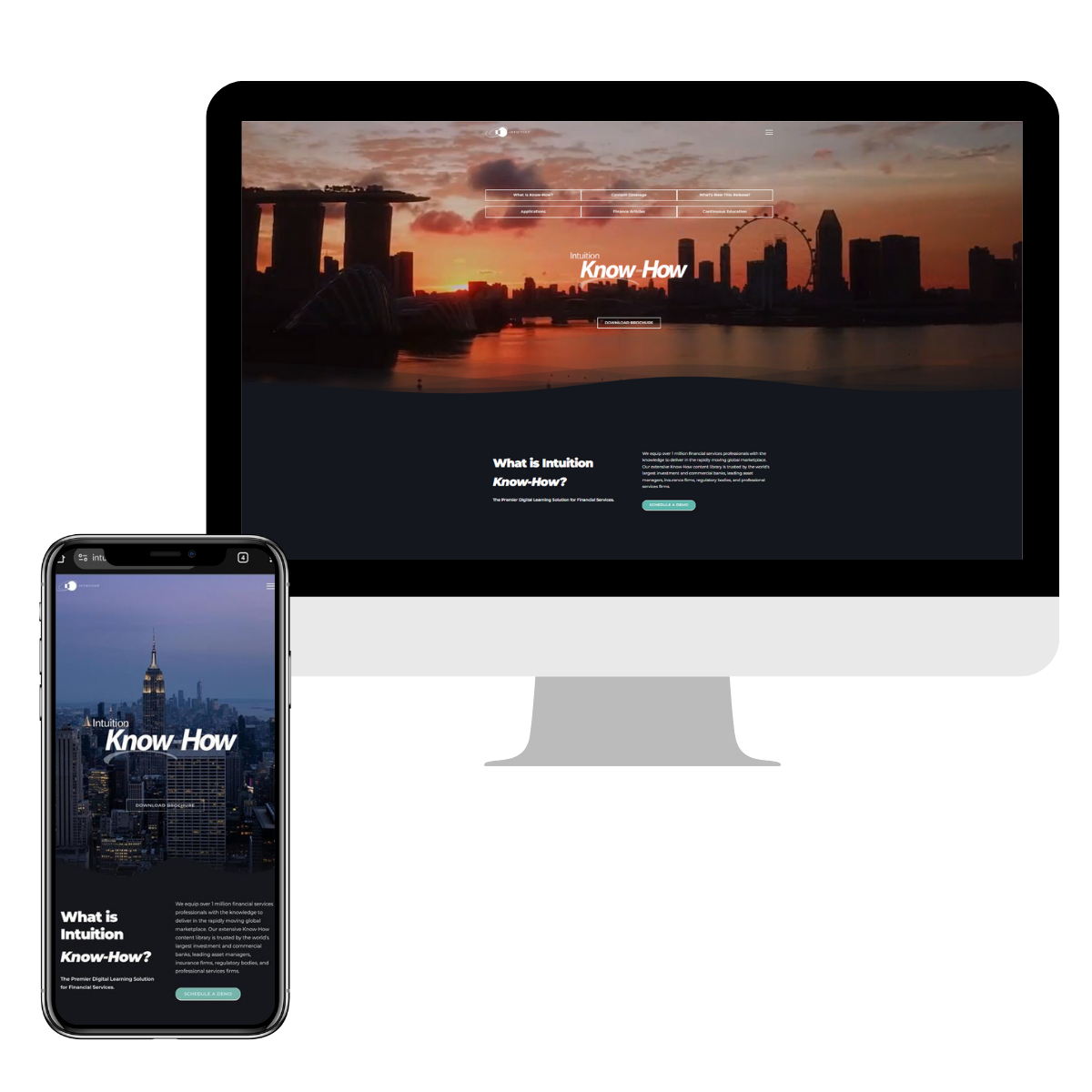
Know-How is Intuition’s flagship digital learning library that helps finance professionals build technical fluency, regulatory readiness, and continuous capability with expertwritten, regularly updated content. Trusted by global financial institutions, it is designed for modern banking and markets environments and enables professionals to stay current and apply learning on the job.
Know-How is Intuition’s flagship digital learning library that helps finance professionals build technical fluency, regulatory readiness, and continuous capability with expertwritten, regularly updated content. Trusted by global financial institutions, it is designed for modern banking and markets environments and enables professionals to stay current and apply learning on the job.
Frequently Asked Questions
Frequently Asked Questions
Talk to our team
Partner with Intuition to develop an early careers program designed for real financial capability.

About Intuition
Intuition is your end-to-end strategic learning partner, empowering your teams with the knowledge and skills to perform, grow, and lead. Built on a legacy in financial services, we now partner with organizations across industries to deliver integrated learning strategies that extend far beyond content. From skills diagnostics and onboarding to leadership development and cultural change, we align learning with business outcomes to drive measurable impact. Backed by four decades of global experience, a world-class expert network, and powerful digital infrastructure, we deliver insight-driven solutions built around your needs. We partner with you to build the skills and strategies your teams need to perform today, and lead tomorrow.
About Intuition
Intuition is your end-to-end strategic learning partner, empowering your teams with the knowledge and skills to perform, grow, and lead. Built on a legacy in financial services, we now partner with organizations across industries to deliver integrated learning strategies that extend far beyond content. From skills diagnostics and onboarding to leadership development and cultural change, we align learning with business outcomes to drive measurable impact. Backed by four decades of global experience, a world-class expert network, and powerful digital infrastructure, we deliver insight-driven solutions built around your needs. We partner with you to build the skills and strategies your teams need to perform today, and lead tomorrow.