


Why risk teams are still seen as growth blockers
About Intuition
Since 1985, Intuition has partnered with leading financial institutions and Fortune 500 companies worldwide to build capability in complex, regulated environments. As an end-to-end strategic learning partner, we help organizations identify, design, and deliver the knowledge and skills their teams need to succeed. Our risk development programs focus on helping risk functions become trusted partners in decision making across the business.
***
In 2026, if you ask most financial institutions how they think about their risk function, you’ll usually hear a similar answer. Risk, they’ll say, should operate as a partner to the business, and not just a partner in theory, but a partner in helping the organization grow.
Across modern financial institutions there’s a fairly broad understanding now that risk shouldn’t exist simply to stop things from happening. The expectation is that risk teams help shape decisions, help organizations navigate uncertainty, and help leadership think through difficult trade-offs so that the business can move forward responsibly while still remaining resilient.
That’s the intention, anyway.
Because when you look at how risk is often perceived inside large financial institutions, the reality can look quite different. The risk function still tends to carry a reputation for being the point in the process where momentum slows down, where conversations that once focused on opportunity suddenly become more cautious, and where a discussion that began with enthusiasm gradually turns into something more procedural.
And the interesting thing is that this perception rarely reflects the intent of the people involved. Risk professionals are typically experienced, thoughtful, and deeply committed to protecting the stability of the organization. At the same time, business leaders are operating under constant pressure to move quickly, respond to markets, and execute on opportunities before they disappear.
So the tension tends to appear somewhere in between.
It shows up in those moments when uncertainty enters the conversation and the dynamic between the business and risk begins to change. And when you look closely at those moments, what you often find is that the difference between a risk function that feels like a barrier and one that feels like a genuine partner often comes down to capability.
Table of contents
- How structured problem solving changes risk conversations
- Why critical thinking matters in risk functions
- Communicating risk without blocking progress
- Rethinking the role of risk
This article is also available in podcast/video form. Watch the video below from our YouTube channel, or follow The Intuition Finance Digest on Spotify, Apple Podcasts, or Amazon Music.
How structured problem solving changes risk conversations
One pattern you see quite often inside financial institutions is that when something complex comes up, the conversation tends to move very quickly toward escalation. A proposal raises a few questions, uncertainty appears, and almost instinctively the response becomes, well, let’s bring in another approval, let’s gather more documentation, let’s move this into a more formal process. Gradually the discussion drifts away from the people who originally raised the issue and into a wider governance structure.
Now, escalation absolutely has its place. In regulated environments especially, there are decisions that need careful oversight and formal review. But when escalation becomes the default response to complexity, something important gets lost along the way.
And that’s the ability for risk teams to actually solve problems.
Because risk professionals are uniquely positioned to do exactly that. When risk conversations are approached through structured analysis rather than immediate escalation, the discussion often starts in a very different place. Instead of asking whether a proposal fits neatly inside existing policy, the risk team begins by unpacking the problem itself. They look at the assumptions behind the proposal, they explore where the real exposures might sit, and they ask whether the underlying objective could still be achieved in a slightly different way that remains within the organization’s risk appetite.
When conversations are framed like that, the dynamic between risk and the business begins to shift quite noticeably. The discussion stops being about whether something needs to be shut down and starts becoming about how it could be structured safely.
A simple example might help illustrate that.
Imagine a business unit proposing a new lending structure for a client entering a market the bank hasn’t really operated in before. The traditional reaction from risk might be to focus immediately on the uncertainty involved, the limited historical data, and the fact that the proposal doesn’t sit neatly inside existing policy. From there it’s not hard to see how the conversation could move fairly quickly toward escalation, or even rejection.
A structured problem-solving approach looks different. Instead of immediately asking whether the proposal fits existing rules, the risk team starts exploring whether the transaction could be reshaped in a way that manages the exposure more effectively. Maybe the collateral structure changes, maybe the exposure is staged over time, maybe the financing is tied to performance milestones that reduce the bank’s downside.
The opportunity itself isn’t rejected outright. It’s redesigned.
And that’s where risk starts to move from being perceived as a blocker to becoming something much more valuable: a partner in figuring out how the business can move forward safely.
The risk management market was valued at $15.40 billion in 2024 and is projected to reach $51.97 billion by 2033, growing at 14.6% CAGR.
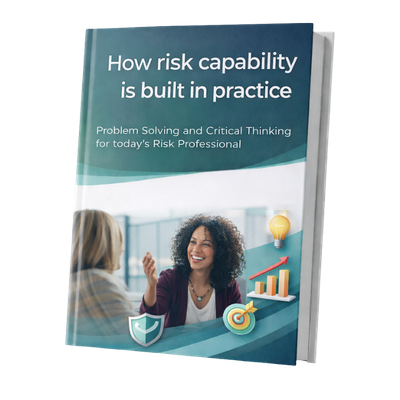
How risk capability is built in practice
This document outlines how we work with risk teams to develop problem-solving and critical thinking capability in practice. It shows how we help risk professionals move from risk avoidance toward risk intelligence, and from rule enforcement toward informed decision support, using real scenarios, practical frameworks, and learning designed to scale.

Why critical thinking matters in risk functions
Closely connected to structured problem solving is something else that really matters in modern risk functions, and that’s critical thinking.
Because the reality is that financial institutions almost never face situations where risk can simply be removed from a decision entirely. Most opportunities come with some level of uncertainty attached to them, and the role of the risk function isn’t really to eliminate that uncertainty. It’s to help the organization understand the trade-offs involved in moving forward.
What does a future-ready financial risk function look like?
So rather than asking whether a decision is completely safe, the conversation becomes more about understanding the different dimensions of the risk.
Critical thinking allows risk professionals to step back and examine the assumptions behind a proposal. They can look at how different scenarios might unfold, how the risk profile might change over time, and what the potential consequences could be if things don’t develop exactly as expected.
And these situations are rarely simple. Strategic considerations, operational exposure, reputational implications, and even behavioral factors inside the organization can all interact in ways that aren’t immediately obvious.
When risk professionals bring that kind of analytical perspective into a discussion, their role starts to look very different. Instead of appearing to control the conversation, they begin to contribute insight that helps the business think more clearly about the decision it’s about to make.
A good example might be a bank considering whether to expand into a new digital payments segment.
On the surface, the opportunity could look commercially attractive. But at the same time it introduces unfamiliar operational risks, new regulatory scrutiny, and potentially new technology dependencies.
A policy-driven response might focus quite narrowly on whether the bank already has procedures in place that fully address those risks.
A critical thinking approach would take a broader view. The risk team might look at how other institutions have entered the space, how operational risk evolves as scale increases, and what governance structures would need to be in place before the expansion becomes sustainable.
In that scenario the outcome isn’t simply approval or rejection. Instead, the conversation produces a clearer understanding of how the opportunity could be pursued responsibly.
And again, that’s where the perception of risk starts to shift. Risk stops looking like a barrier and starts looking like a source of perspective that helps the organization make better decisions.

Communicating risk without blocking progress
Even when the analysis itself is strong, its influence really depends on how well it’s communicated.
Risk professionals often work with highly technical frameworks and regulatory language, and while that language is essential inside the function, it can sometimes feel quite distant from the way the business thinks about decisions. When risk conversations are framed entirely in terms of policies, controls, or compliance obligations, what the business often hears is constraint.
And that’s where the dynamic can start to break down.
Because the ability to communicate risk in business terms changes the entire tone of the discussion. When risk insights are translated into clear explanations about potential exposure, strategic implications, and what options actually exist moving forward, people engage with the conversation very differently.
Very often the difference between a stalled conversation and a productive one isn’t the analysis itself. It’s how that analysis is framed.
A simple example might be a bank considering a partnership with a fintech firm.
The risk team might identify that the relationship introduces operational dependencies and reputational exposure through a third-party provider. If the message to the business is simply that the arrangement creates “unacceptable third-party risk,” the conversation is likely to end quite quickly.
But if the same analysis is communicated in more practical terms, the conversation can move in a completely different direction. The risk team might explain where the operational dependencies sit, what failure scenarios could look like, and what controls would need to exist to manage those risks effectively.
At that point the discussion isn’t about shutting the partnership down. It becomes a conversation about what needs to be in place for the relationship to succeed.
And again, that’s where the perception of risk begins to shift.

Rethinking the role of risk
The perception of risk as a growth blocker usually doesn’t emerge because risk teams are trying to slow things down. More often it develops gradually, over time, when conversations about uncertainty drift toward process instead of analysis, and when the interaction between risk and the business starts to feel procedural rather than genuinely collaborative.
Changing that perception isn’t about removing governance or relaxing standards. Financial institutions still need strong frameworks and oversight.
What actually shifts the dynamic is capability.
When risk teams become stronger at structuring problems, thinking carefully about trade-offs, and communicating their thinking clearly, something interesting starts to happen. Conversations that might previously have ended in escalation begin to move toward resolution. Discussions that once focused almost entirely on limitation start to open up into conversations about what might still be possible.
Over time, the same risk function that might once have been seen as slowing the business down gradually becomes one of the groups people turn to when decisions become difficult.
And in an environment where uncertainty is unavoidable, that ability to help the organization make better decisions may well be one of the most valuable contributions a risk function can make to long-term growth.
Frequently asked questions
Why are risk teams still seen as growth blockers in financial institutions?
Risk teams are often perceived as growth blockers because momentum tends to slow when uncertainty enters a discussion. Conversations that begin around commercial opportunity can become more procedural, with added approvals, documentation, and escalation. This usually does not reflect the intent of risk professionals. More often, it happens when risk-business interactions default to process rather than collaborative analysis and problem solving.
What makes the difference between a risk function that feels like a barrier and one that feels like a partner?
Capability is often the deciding factor. A risk function feels like a partner when professionals can structure problems clearly, think critically about trade-offs, and communicate insights in business terms. These capabilities help shift conversations away from stopping activity and toward finding responsible ways to move forward within the institution’s risk appetite and governance expectations.
How does structured problem solving improve risk conversations?
Structured problem solving changes risk conversations by focusing first on the nature of the issue rather than immediately escalating it. Risk professionals unpack assumptions, identify the real exposures, and explore whether the objective can be achieved through a different structure. This helps the discussion move from “should this be stopped?” to “how can this be done safely?” which creates a more constructive relationship with the business.
Why does critical thinking matter more than policy alone?
Policy is important, but most financial decisions involve uncertainty that cannot be removed entirely. Critical thinking allows risk professionals to examine assumptions, test scenarios, and assess consequences across strategic, operational, reputational, and behavioral dimensions. That broader analytical perspective helps risk contribute insight rather than simply checking whether a proposal fits existing procedures or policy boundaries.
How can risk professionals communicate in a way that does not block progress?
Risk professionals can avoid sounding like blockers by translating technical analysis into language that connects with business priorities. Instead of framing concerns only through controls, policies, and compliance obligations, they can explain specific exposures, likely implications, and practical options. When decision-makers understand what could happen and what needs to be in place, they are more likely to engage with risk analysis constructively.
Does becoming a better growth partner mean relaxing governance or standards?
No. Changing the perception of risk does not require removing governance or lowering standards. What matters is developing the capabilities that allow risk professionals to engage with complexity more constructively. Stronger problem structuring, critical thinking, and clearer communication help risk teams support better decisions while still protecting the institution’s resilience and staying within risk appetite.
How risk capability is built in practice
This document outlines how we work with risk teams to develop problem-solving and critical thinking capability in practice. It shows how we help risk professionals move from risk avoidance toward risk intelligence, and from rule enforcement toward informed decision support, using real scenarios, practical frameworks, and learning designed to scale.
