


Fixing capability leakage in risk teams
About Intuition
Since 1985, Intuition has partnered with leading financial institutions and Fortune 500 companies worldwide to build capability in complex, regulated environments. As an end-to-end strategic learning partner, we help organizations identify, design, and deliver the knowledge and skills their teams need to succeed. Our risk development programs are designed to help risk functions strengthen judgment, improve consistency, and operate with greater confidence in real decision-making environments.
***
Most risk teams today are not lacking frameworks, training, or technical knowledge. In many cases, they are well supported, well governed, and equipped with the tools they need to do their jobs effectively. On paper, capability looks strong.
And yet, when risk has to be managed in real conditions, under pressure, with incomplete information, competing priorities, and decisions that are not always clear-cut, a different issue begins to emerge. The challenge is not always what people know. It is whether that capability holds when it needs to be applied in practice.
This is where capability leakage starts to matter. It is rarely visible as a major breakdown. More often, it appears in slower decisions, uneven judgment, inconsistent escalation, and different interpretations of the same framework across teams. Over time, those small gaps become more significant, shaping how risk is experienced across the business and how effectively the function supports decision-making.
Capability leakage does not sit on its own. It forms part of a broader set of pressures shaping how risk teams operate today, reflected in Top 6 challenges for risk teams in 2026
Table of contents
- Where capability starts to leak
- How capability leakage shows up in practice
- Why it happens, even in well-trained teams
- Why this is an L&D problem
- What needs to change in how capability is built
- Where stronger capability starts to show
This article is also available in podcast/video form. Watch the video below from our YouTube channel, or follow The Intuition Finance Digest on Spotify, Apple Podcasts, or Amazon Music.
Where capability starts to leak
If you look across most risk functions today, there’s no obvious shortage of knowledge. Teams understand the frameworks they’re working within, they’re familiar with the models and methodologies that underpin decision-making, and they operate in environments that are, on paper, well governed and clearly structured. From the outside, it would be reasonable to assume that capability is strong and that decisions should follow accordingly.
And yet, when you look more closely at how risk is managed in practice, a different picture starts to emerge. Decisions take longer than expected, similar situations are handled in different ways across teams, and in moments where the answer isn’t immediately clear, confidence can drop off more quickly than it should. It’s not that people don’t know what to do, it’s that the capability doesn’t always show up in the moment it’s needed.
That’s what sits behind capability leakage.
It’s not about knowledge disappearing over time or expertise being lost through turnover, although those things can happen. It’s about something more subtle and more pervasive, which is the gap between what people know and how they behave when they’re required to apply that knowledge in real situations.
This helps explain why risk teams are still sometimes associated with friction rather than forward movement, read more about this in this piece: Why risk teams are still seen as growth blockers.
How risk capability is built in practice
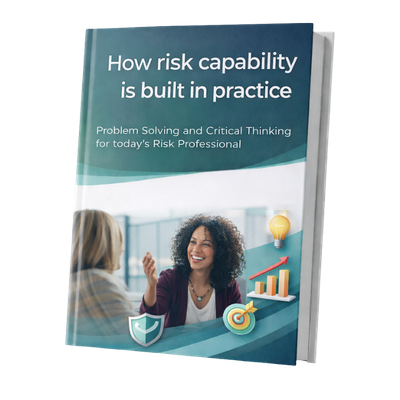
This document outlines how we work with risk teams to develop problem-solving and critical thinking capability in practice. It shows how we help risk professionals move from risk avoidance toward risk intelligence, and from rule enforcement toward informed decision support, using real scenarios, practical frameworks, and learning designed to scale.
How capability leakage shows up in practice
In most cases, capability leakage doesn’t appear as a clear or dramatic failure. It tends to show up in smaller, more familiar ways that are easy to overlook in isolation but become more significant over time.
You might see it when early warning signs are identified but not escalated, either because they don’t feel material enough or because there’s uncertainty about what action should follow. You see it when models are relied on too heavily, with outputs taken at face value without enough challenge around assumptions, data quality, or relevance to current conditions. And you also see it in the opposite direction, where models or frameworks are bypassed altogether because the situation feels different or because there’s pressure to move quickly.
It also shows up in how policies are interpreted. In theory, frameworks are designed to provide clarity and consistency, but in practice, they’re often read in slightly different ways depending on experience, confidence, and context. Over time, those differences lead to inconsistent decisions, even when everyone’s working from the same underlying structure.
None of this reflects a lack of training. It reflects a breakdown in how that training is applied.
Why it happens, even in well-trained teams
Once you start to look at it through that lens, the reasons become clearer. Risk management doesn’t take place in controlled, classroom conditions. It happens in environments where information is incomplete, where time is limited, and where decisions often need to be made before everything is fully understood.
In those situations, human behavior starts to play a much bigger role than frameworks alone would suggest. People rely on judgment, but that judgment is influenced by pressure, by experience, by incentives, and sometimes by overconfidence. There’s a natural tendency to trust outputs that appear precise, even when the underlying assumptions are uncertain, or to lean on process as a way of reducing accountability when the path forward isn’t clear.
At the same time, escalation, which is designed to be a control mechanism, can become a default response rather than a deliberate one, particularly when individuals aren’t fully confident in their own interpretation of the situation. And while all of this is understandable, it creates an environment where capability becomes uneven, not because people lack knowledge, but because they apply it differently under pressure.
That’s where leakage really happens.
If capability is leaking in the moments that matter most, the question is not simply what people have been taught, but how development has been designed. Read more here: Why traditional risk training falls short in 2026.
Why this is an L&D problem
For learning and development leaders, this is where the conversation needs to shift.
Most risk training is designed to build a strong foundation of knowledge, which is entirely appropriate. The frameworks, the models, the regulatory requirements, they’re essential, and without them there’s no consistency, no shared language, and no basis for governance.
But if development stops there, it leaves a critical gap.
Because the effectiveness of a risk function isn’t determined solely by what people know, it’s determined by how they interpret, challenge, and apply that knowledge in situations that aren’t clearly defined. That’s where capability either holds or starts to leak, and it’s also where traditional approaches to training tend to fall short.

What needs to change in how capability is built
Closing that gap doesn’t come from adding more content or expanding existing programs in the same way. It requires a shift in how capability is developed in the first place.
Training needs to move beyond explaining frameworks and toward helping people interpret them, particularly in situations where the answer isn’t obvious. That means creating learning experiences that reflect real conditions, where information is incomplete, where trade-offs need to be made, and where different interpretations can be explored and challenged.
It also means placing more emphasis on how people engage with the tools they’re given. Not just how to use a model, but how to question it. Not just what the policy says, but how to apply it when the situation doesn’t fit neatly within its boundaries. And not just when to escalate, but how to take ownership of a decision before escalation becomes necessary.
Equally, it requires reinforcing the behaviors that support a strong risk culture, encouraging people to surface concerns early, to challenge assumptions constructively, and to communicate their thinking in a way that others can act on.
What this requires in practice is a more applied approach to capability development, which can be explored further in How to build stronger risk capability in practice.
Where stronger capability starts to show
When capability is built in this way, the difference isn’t theoretical, it becomes visible quite quickly in how the function operates.
Decisions move forward with greater clarity, not because risk is being taken more lightly, but because it’s being understood and communicated more effectively. Escalation becomes more targeted and purposeful, rather than a default response to uncertainty. And perhaps most importantly, there’s greater consistency in how similar situations are handled, even across different teams and levels of experience.
Over time, that changes how risk is experienced across the organization. It becomes less about enforcing rules and more about supporting decisions, less about slowing things down and more about helping the business move forward with a clearer view of what sits ahead.

Most organizations don’t have a knowledge problem in risk.
They have capability that doesn’t always carry through into real decisions, particularly in the moments where conditions aren’t ideal and judgment matters most.
That’s what capability leakage really is.
And for L&D leaders, the opportunity isn’t just to build knowledge, it’s to make sure that capability holds under pressure, in ambiguity, and in the everyday situations where risk is actually managed.
Frequently asked questions
What is capability leakage in risk teams?
Capability leakage in risk teams is the gap between what people know and how they behave when they need to apply that knowledge in real situations. It is not mainly about missing knowledge or weak frameworks. It shows up when strong technical understanding does not carry through into clear, confident, and consistent decision-making under pressure, ambiguity, or incomplete information.
How does capability leakage usually show up in practice?
Capability leakage usually appears in subtle ways rather than obvious failures. Early warning signs may be identified but not escalated, models may be accepted too quickly without enough challenge, or frameworks may be bypassed when situations feel unusual or urgent. It also appears when policies are interpreted differently across teams, creating inconsistent decisions even when people are working from the same structure.
Why can capability leak even in well-trained risk teams?
Capability can leak even in well-trained teams because risk decisions are not made in controlled conditions. They happen when information is incomplete, time is limited, and judgment is affected by pressure, experience, incentives, and confidence. In those moments, people may trust precise-looking outputs too easily, rely too heavily on process, or escalate by default when they are unsure how to interpret the situation.
Why is capability leakage an L&D issue?
Capability leakage is an L&D issue because traditional risk training often focuses on building knowledge rather than strengthening application. Frameworks, models, and regulatory requirements remain essential, but they do not guarantee effective judgment in unclear situations. If development stops at technical understanding, it leaves a gap between learning and performance, especially in the moments where interpretation, challenge, and ownership matter most.
What needs to change in how risk capability is built?
Risk capability needs to be built through more applied learning, not simply more content. Training should help people interpret frameworks in uncertain conditions, question models rather than just use them, and make decisions before escalation becomes the default response. It should also reinforce behaviors that support a strong risk culture, including surfacing concerns early, challenging assumptions constructively, and communicating judgment clearly.
What changes when risk capability holds under pressure?
When risk capability holds under pressure, decisions move forward with more clarity and consistency. Escalation becomes more targeted, similar situations are handled in more aligned ways, and the risk function supports decision-making more effectively across the business. Over time, risk is experienced less as a source of friction and more as a function that helps the organization move forward with a clearer view of what lies ahead.
How risk capability is built in practice
This document outlines how we work with risk teams to develop problem-solving and critical thinking capability in practice. It shows how we help risk professionals move from risk avoidance toward risk intelligence, and from rule enforcement toward informed decision support, using real scenarios, practical frameworks, and learning designed to scale.
